Monday, 23 September 2013

In the latest Guncotton blog piece (ed. Jacinta Le P), for Cordite Poetry Review, Jen Jewel Brown discusses Paul Kelly's most recent musical endeavour, the 'Conversations with Ghosts' CD,  built around powerful, iconic poetic texts such as Kenneth Slessor's 'Five Bells', Judith Wright's 'Woman to Man' and poems by Dickinson, Yeats and Les Murray.
http://cordite.org.au/guncotton/collaborative-kelly-stalks-arcane-new-ground/


Collaborative Kelly Stalks Arcane New Ground

15 September 2013
Collaborative Kelly Stalks Arcane New Ground
And to the bottom I will follow
Conversations with Ghosts (CD) by Paul Kelly
Australian Broadcasting Corporation, 2013

While a long-time voracious song-writer and performer in his own right, Australian musician Paul Kelly has also been a collaborative nomad, drawn to criss-cross with others during his career. And Kelly’s collaboration most likely to grip poets is also his most recent – Conversations with Ghosts – an ambitious song-cycle of twelve haunting poetic texts.
First performed in 2012 and reprised live this September with concerts in three states, Conversations with Ghosts began in 2010 when the South Melbourne-based Australian National Academy of Music (ANAM) proposed to Kelly that he collaborate with the school on a modern classical song cycle. In the CD liner notes, his co-composer and conductor James Ledger (then resident at ANAM) recalls two of the works – the musical re-imagining of W.B. Yeats’ poem, ‘The Lake Isle of Innisfree’ and Kelly’s own lyric, ‘The Chimes at Midnight’ – came as a quick birth, in a couple of hours, Ledger at the piano, Kelly singing alongside.
Live, the Melbourne Recital Centre performance I saw in October last year felt like a grand strike for poetry, with the centrepiece, Kenneth Slessor’s mighty ‘Five Bells’, sombrely and conversationally rolled out by Kelly, whose poetic memory through a long night of mostly spoken, part-sung word was notable.
So dark you bore no body, had no face, 
But a sheer voice that rattled out of air ...
That such a wild and sustained poem – Slessor’s mourning of his mate’s drowning – should be re-imagined within a modern classical and slightly rock setting is something to celebrate.
And ‘Five Bells’, given this kiss of life, still seems so quintessentially Australian, and, of its time (1930s), bohemian:
In Sydney, by the spent aquarium-flare
Of penny gaslight on pink wallpaper,
We argued about blowing up the world,
But you were living backward ...
The sounds of ANAM’s young post-graduate ensemble vaunted high and crisp into the ribs of the Elizabeth Murdoch Hall in the Melbourne Recital Centre, in complex classical arrangements for the likes of Emily Dickinson’s ‘One Need Not Be a Chamber To Be Haunted’, Scottish poet Norman MacCaig’s ‘Basking Shark’, and more from Australia’s canon with Les Murray’s ‘Once in a Lifetime, Snow’ and Judith Wright’s ‘Woman to Man’.
The other-worldly, apocalyptic and cryptic Yeats is given a second jolt to the heart with a sophisticated orchestration for his ‘Sailing to Byzantium’, whose opening sally, ‘That is no country for old men’ is familiar to many, not least as inspiration for the title of the Oscar-winning film of 2007, directed by the Coen brothers. The ongoing melancholic – and salutary – ringing of bells in Conversations with Ghostscontinues with ‘Ring Out, Wild Bells’ (from ‘In Memoriam A.H.H.’) by Tennyson:
The year is dying in the night;
Ring out, wild bells, and let him die.
Viola and harp work were highlights live, and violins, keyboards, double bass, clarinet, saxophones, French and other horns, percussion and frequent lead lines from the variegated recorders of soloist Genevieve Lacey unfolded compositions, by turns, experimental and occasionally (although not uncomfortably) traditional, with the Celtic tang often expected from Kelly. Ledger’s work with the baton brought the disparate elements together with authority.
The performances of ANAM’s players, among the best post-graduate musicians in the country, and Kelly’s casual, yet spine-tingling narrations – his brassy voice often soaring above the ensemble like a cornet – are sharply arranged and recorded on disc. Lacey’s recorder takes a rather clichéd ‘ghostly’ approach in the overture ‘The Lake Isle of Innisfree’, but this could have been a rare failing in arrangement. Kelly’s ‘captain’s pick’ of most of the poetry, his occasional acoustic guitar and his own four lyrical contributions set an unpretentious tone, while Ledger’s complexities of orchestration, including dissonant passages, were strongly played by the young virtuosos.
The closest thing, for Kelly fans, to this collaboration would be the filmic light operaOne Night the Moon (2001, directed by Rachel Perkins) where the more than worthy soundtrack was co-written by Kelly, Kev Carmody and Mairead Hannan; while his crackling, part-improvised (with Professor Ratbaggy) soundtrack to Lantana (Ray Lawrence – also 2001) is another genre-stretching and unsettling long-player.Conversations with Ghosts stands well alongside these two as yet another powerful Paul Kelly collaboration.


Disclaimer: Jen Jewel Brown is is an ex-sister-in-law of Paul Kelly.
This entry was posted in GUNCOTTON and tagged . Bookmark the permalink.

Tuesday, 17 September 2013

In the renewed, regular series of 'Notes From' at Cordite Journal's blogsite, Guncotton, we commission pieces by travelling poets and writers where they reflect on current or recent journeys. Korean-based Australian poet, writer and scholar Dan Disney writes a fascinating piece here on Armenia's capital city Yerevan - and the terrific struggles and courageous faith of writers and artists working there. Proposals to the series are welcome - I am the blog editor - E: jlep@netspace.net.au

http://cordite.org.au/guncotton/yerevan-dan/


Notes from Yerevan, Armenia

1 September 2013
Notes from Yerevan, Armenia
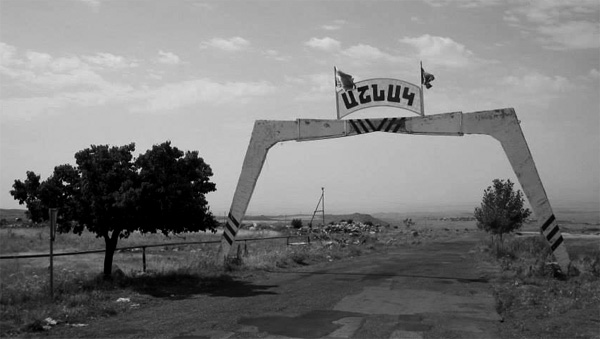
First impression: Yerevan undulates out the semi-desert, ringed with what look suspiciously like nuclear reactors. Flight SU1860 jolts down at (the recently privatised) Zvartnots airport, and we pass a dis-assemblage of passenger jets in various states of stripped-down decay. In the snow-capped distance, and just over the border with Turkey, Mount Ararat landmarks the otherwise small-hilled afternoon, a daily taunt here to national pride. In 1921, Stalin, Atatürk, and others sat down to reset national boundaries (during the Treaty of Kars): from uptown and dropping into Yerevan’s city centre, it feels like a bay should establish the city’s fringe. Instead, there’s that distant tidal wave of the now-Turkish mountain, where mythology tells us Noah parked his improbable floating zoo.
This stone city is built on the ruins of ancient Erebouni (782BCE), and has been criss-crossed by successive marauders (including Assyrians, Persians, Arabs, Byzantines, Mongols, Turks). It is one of the world’s oldest, continually inhabited cities. The currency is adorned with poets: Hovannes Toumanian (1869-1923) is commonly regarded as the father of modern Armenian letters, while the brilliant Yeghishe Charents (1897-1937) died a counter-revolutionary during the Soviet purges. When I hand over a few notes of Armenian dram in exchange for a visa, the border guard hands back a ‘shnorhakalut’yun’ (thank you), and then ‘welcome you, mister’.
Visiting in 1990, the renowned Polish writer Ryszard Kapuściński writes thus of Armenia:
The history of Armenians is measured in millennia. We are in that part of the world that is customarily called the cradle of civilization. We are moving among the oldest traces of man’s existence … The fate of Armenians: centuries of persecutions, centuries of exile, diaspora, homeless wandering, pogroms. (Kapuściński 1995: 46; 231)
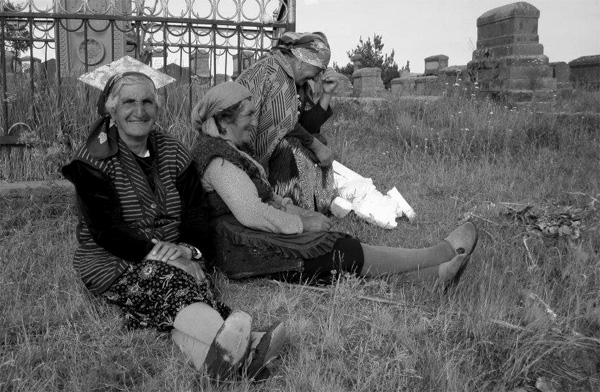
This wind-bitten place was a dormant village until 1918, when the Soviets turned Yerevan into Armenia’s capital (the country’s thirteenth). Today it is full of young families and bent police and huge, brutal, upright statues and unkempt parks and public squares bustling with flea markets and sun and overcrowded, dustymashutkas (mini-buses) which jostle across town at 27¢ per ride. I am here as a guest of Mkrtich Tonoyan, director of the Armenian-based arts residency program ACOSS. This monolithic 37 year old is a former teen paramilitary, and carries books likeEducation for Socially Engaged Art with him everywhere. Tonoyan lives by his ethics like few other artists I know: any money generated by ACOSS is channelled directly into projects for children and socially-disadvantaged groups.
During my month-long stay as an ACOSS writer-in-residence, he delivers a new turbo charger to a rehabilitation centre’s inert bus and, when he visits an association for blind veterans in Stepanakert (the de facto capital of Nagorno-Karabakh Republic, which remains disputed territory), he promises to fund twenty new handheld laser guidance devices. Tonoyan lives in a tiny apartment on the outskirts of Yerevan, together with his mother and grandmother, wife and three kids. We can’t walk 20 metres in this part of town without somebody clutching him in a bear hug. And anything growing on trees in his garden is prima materia: the aim is for home-made vodka which is 96% proof, a liquid corrosive for the psyche. The parties in his studio attract artists from across the Caucasus.
Notes from Yerevan, Armenia
Firmly hand-in-hand into the future with Russia, Armenia remains at loggerheads with pro-American, neighboring Georgia. To talk of some of the other neighbours only raises eyebrows and blood pressure: the war with Azerbaijan is ongoing (at best, a ceasefire), and everyone has an evenings’-worth of outcry over the Turkish-led genocide, which started in 1915 and ended up in one and a half million Armenian deaths later. And though the Soviets left in 1991, they left a culture of censorship behind – as Armenia’s foremost avant-garde poet, Violet Grigoryan, based in Yerevan, knows only too well. Cultural commentator and raconteur par excellence, Grigoryan once hosted her own TV show … which the state closed overnight for its ‘inappropriate’ political content. In her introduction to Deviation: Anthology of Contemporary Armenian Literature (2008), she contests that:
The concept of ‘drawer’ literature first emerged during perestroika, referring to works that authors hid in drawers … A long time has passed since the collapse of the Soviet Union and the disappearance of state-mandated censorship. Nevertheless, the censorship survived in the people’s spirit and in those who continued to govern the literary world. (Grigoryan 2008: 7)
So what to do when confronted (as she perceives it) with a cultural economy regulated by reactionary bean-counters? Grigoryan persists with making space to escape institutionalised censorship; she purposefully antagonises any valorised group (‘Academia, the Literature Departments, the publishers and the Stalin-styled creative unions’: Grigoryan 2008: 7), through fostering writing which employs non-normative styles. She is part of a raucous group – the Inknagir Literary Club, based in the city – that demands freedom, plurality, and empowerment. Members are frequently blacklisted, despised for themes which include homosexuality (still largely unmentionable in Armenia), sexual violence, suicide, necrophilia. One academic states that Grigoryan’s cohort are:
Demolishing all the moral, ideological, and spiritual standards in their wake. Preaching their message of verbal freedom, they dragged into literature the stratum of language that has no place in the dictionaries and … literally exudes the stench of decay. (Zhenia Kalantaryan, cited in Grigoryan 2008: 9).
For the Inknagirs, reactions like this means their impact on contemporary Armenia literature is already a fait accompli.
And so, in this small and landlocked country where 80% of the borders are closed and the threat of missiles dropping over Yerevan looms (to almost every Armenian’s dismay, Russia recently sold US$4 billion of arms to oil-rich Azerbaijan), creative producers are struggling to make sense of their role after the death of the Marxist drive toward utopia: are they social workers or social misfits? Is an artist an activist rebuilding communities through art, or a destinateur of programmatic bad taste, smashing everything so as to start again? Either impulse speaks to ideas of engagement and idealism. Tonoyan and Grigoryan embody competing impulses in a dynamic scene populated by artists living each to authentic visions of aesthetic function: in a place where there is almost no opportunity for creative producers to receive support for their work, the Armenian artists I met would welcome visits from funded, comparatively wealthy First World poets. Next time you receive funding or win a prize, consider visiting.
Works cited
Violet Grigoryan and Vahan Ishkhanyan (eds) 2008 Deviation: Anthology of Contemporary Armenian Literature. Yerevan: Inknagir Literary Club, 2008.
Ryszard Kapuściński (trans Klara Glowzewska). Imperium New York: Vintage Books, 1995.
This entry was posted in GUNCOTTON and tagged , , , . Bookmark the permalink.


Friday, 9 August 2013

INTERNATIONAL POETRY FESTIVAL MEDELLIN 2013


 and 
Notes from Medellín, Colombia

1 August 2013
Since it began 23 years ago, the Internacional de Poesía de Medellín has grown to become a major poetry festival in the world, in a country riven by 50 years of civil war. This year’s Festival (6-13 July) coincided with a new round of peace talks in Havana between the Colombian Government and FARC, and FARC rebels reportedly fighting security forces in the mountains. The Festival featured Australian poet Les Wicks, who reports on his experience below. The Festival has also ‘grown’ up alongside seismic changes for the city of Medellín, Colombian’s second-largest and once described as the ‘most violent city in the world’ (Time, 1988), due to its brutal cocaine drug-cartel culture. This year, in February, it was nominated instead as the ‘World Capital’ of innovation, by the Wall Street Journal and the Urban Life Institute, following civic projects aimed at radically improving life and security for its citizens – and its reputation.
At the same time, a UN report condemned the city for being among the most unequal in the world, due to ongoing murders, ‘disappearances’, unemployment and criminal gang warfare. The Festival was started two years before the killing of drug-cartel kingpin Pablo Escobar in 1993 by Colombian National Police, and three years before the publication of Colombian-born author and film-maker Fernando Vallejo’s well-known novel, La virgen de los sicarios (Our Lady of the Assassins) – which spawned a new genre of novel known as narcorrealismo, narcotrendismo or la novella sicaresca, fiction drawing on the violent themes of the drug trade. Vallejo was born in Medellín but has lived in Mexico since 1971, and renounced his Colombian nationality in 2007 (becoming Mexican), citing his political dissent in a public letter. The Festival, which this year expressly endorsed support for the current Havana talks, was conceived by its founders to be an initiative of peace, a form of cultural resistance, and in 2006 was awarded the prestigious ‘Right Livelihood Award’, a prelude and alternative to the Nobel Peace Prize. (JLP)
Internacional de Poesía de Medellín
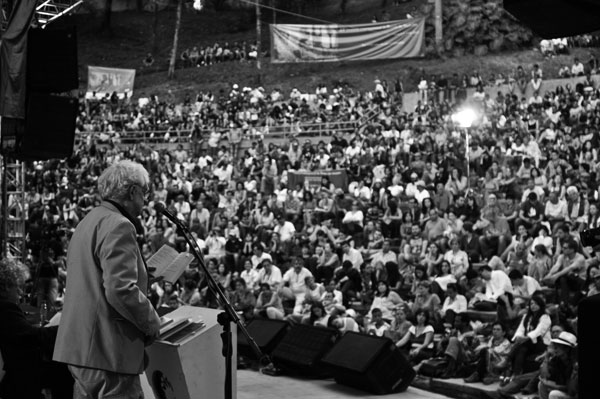
Norwegian poet Jan Erik Vold at the Teatro Carlos Vieco | image by Sara Marín
Daz(zl)ed
Okay. Around 5000 people were gathered in the generous heat of this amphitheatre, holding events from the 23rd Festival Internacional de Poesía de Medellín. A diverse crowd from children to seniors chattered animatedly amongst themselves as vendors moved along the rows selling popcorn and Coca-Cola. Television cameras fidgeted at the hem of the stage, broadcast lighting came on as sound techs stroked their dials. For an Australian poet, the crowd and attention seemed inexplicable – this was a poetry reading.
Colombia has been a nation at war with itself for 50 years. The toll of death and displacement is staggering. There are currently talks ‘underway’, there always seems to be talks underway. Twenty-three years ago some poets got the idea of responding to a culture of violence with poetry. The Festival was born. For an Australian – with our marginalised poetics – this notion might seem something like fighting fire with feathers. But in Latin America, as has been the case with other territories with long histories of war and civil dissent, political foment has often seen poetry and poets championed – and read – by the masses. Poetry considered relevant, and powerful, as a tool of revolution.
Early on, expecting perhaps only hundreds to attend, the organisers found public interest overwhelming and the nine-day event has grown to become a major fixture in the city’s calendar and the largest poetry festival in the world. It is attended by fervent audiences, and has inspired and supported a number of other new poetry festivals around the world. This year there were to be a total of 220 readings involving 66 poets from 41 countries. Venues are mostly in Medellín but there was a solid program of forays into other centres. I am this year’s Australian guest. It’s fundamentally important that we have a presence at gatherings like these. The Australia Council Literature Board covered the airfare while Macquarie University organised my Spanish translation with Judith Mendoza–White. Vastly appreciated further translation came from Raphael Patiño Góez and George Leogena. I have always argued that for our poetry in Australia to ‘work’, we need commitment, clear planning and sustained effort/support over time. This Colombian festival took off from its first year. Does this mean we have to change, back home, a people?
That amphitheatre – Teatro Al Aire Libre Carlos Vieco – was the site of the opening reading. The range of voices reading from the stage were astonishing; Lorna Shaughnessy (Northern Ireland) quietly shared the pain of internal conflict with Vietnamese-born Nguyen Phan Que Mai. Sainkho Namtchylak (Tuva) performed her famous throat-based work. Thiago de Mello, a grandfather of Colombian poetry, had the crowd screaming for more. It amiably forgave my woeful Spanish, seemed to enjoy the English versions of my poems, and loved the Spanish ones read by theatre director Wilson Zapata, who was to be my reader throughout the Festival. Later, as I was exiting the toilets, I was bailed up by an eager Colombian who wanted to show off his skills on the didgeridoo he had purchased in Ecuador. The tunnels under the stage became tunnels within my head as fellow urinators quietly smiled.
The days that followed were a crazy blend of intense multicultural dialogue, hugs and photos. Around 100 people came to the reading the next day in the working-class suburb of Carrera. That was the hall’s capacity. People were turned away. The workshop group hosting this event was celebrating its 20th year, and we all know how hard it is to sustain voluntary organisations over time.
Monday, a group of us flew to Apartado, a smaller city of around 180,000, for another capacity audience of 200 with my translations read by Mark Vender, an Australian living there, who is the convener of the city’s writers’ group. Tuesday saw a ‘disappointment’ with our first non-full house, a mere 65 people. Wednesday saw a mildly hair-raising 3 ½-hour trip across the mountains to Ciudad Bolivar. Thursday, Friday, reading, reading – the level of engagement with art across society in Colombia is simply remarkable. Vender told me he’d travelled the world and everywhere else seems to be sinking into a sediment of monocultural, consumerist tepidity. To him, only the people of Colombia (and maybe Brazil) appear content to be going their own way. That way is a long stretch short of perfect – there were gunshots last night outside the hotel. Colombia has critical problems. But it is definitely special.
It was also deeply energising to immerse myself further in the poetics of South and Latin America, which were obviously numerically dominant in the line-up. With the expected influence of Pablo Neruda and Octavio Paz, the New Baroque still exploring new territories – here was a body of work that was mostly vigorous, linguistically and emotionally robust, whilst profoundly engaging with their readers.
Other impressive poets: Tanure Ojaide, Josaphat-Robert Large, Javier Bello, Marra PL Lanot, K Satchidanandan, Maram Al-Masri, Moya Cannon, Ingrid Fichtner, Magnus William-Olsson, Gedour Kristny, Lidija Dimkovska and Tiziana Cera Rosco.
An Australian is invited most years to this festival. It is a pinnacle of a poetic life, professionally demanding and wholly satisfying. Today, as I write, is the closing ceremony (4pm-midnight) where all poetry guests will read one piece. The usual attendance for this final day is around 15,000. Breakfast was laconic – a lack of sleep and a regime of daily appearances has left us wrecked’n’ready. So … (LW)

Friday, 2 August 2013

ON ALBERT CAMUS, ALGERIA AND POLITICS


Published this week, an article examining Albert Camus's final writings,

at The Wheeler Centre's 'Dailies' webpage:


Exile and Silence: On Albert Camus, Algeria and Politics

By Jacinta Le Plastrier
When Albert Camus died, he had been sidelined by his fellow left-wing intellectuals for his opposition to Algerian independence and his condemnation of Stalin’s gulags. Fifty-five years later, writes Jacinta Le Plastrier, his stance on both issues has withstood the assault of time far better than his contemporaries.
And the long overdue release of his final book, Algerian Chronicles, translated into English for the first time, reveals the fault-lines of Camus’s approach to his birth-country, in passionate reportage that spans the 1930s through to the 1950s.

Albert Camus published the final book of his lifetime, Algerian Chronicles, in Paris in 1958. The great writer’s final work – his own selection of his deeply haunted articles on his birth-country Algeria and the question of its independence − was met by an almost complete critical silence. That silence continued to reverberate following his early death two years later.
Albert-Camus-74_lg
The reason for this public disdain was twofold. Camus had been traumatically sidelined by other European-based left-wing hommes engages such as Jean-Paul Sartre, not just for his opposition to Algerian independence, but for his condemnation of Stalin’s gulags.
Fifty-five years later, Camus’s passionate discourse − and his almost solitary intellectual and activist stance, on both issues − has withstood the assault of time far better than his contemporaries. In the light of this, the long-overdue, full English translation of Algerian Chronicles is presciently relevant.
‘Dismissed or disdained in 1958, Algerian Chronicles has a new life in 2013, a half-century after the independence Camus so feared,’ writes editor Alice Kaplan in her introduction to this new edition. ‘The book’s critique of the dead end of terrorism − the word appears repeatedly, with respect to both sides of the conflict − its insistence on a multiplicity of cultures; its resistance to fundamentalisms, are as meaningful in contemporary Algeria as in London or New York. Camus’s refusal of violence speaks to Algerians still recovering from the civil war of the 1990s – “the dirty wars”, or “black decade” that resulted in an estimated 100,000 civilian deaths.’
In Algerian Chronicles, which gathers his reportage on his birth-country from the 1930s to the 1950s, Camus meshes the machinery of journalistic ‘on-the-grounds’ reportage with what would become his literary hallmark: an austere styling of language whose results are both exquisite and intensely humane.
In the book’s first series, Camus describes the ‘misery’ of the mountain-based Kabyle community, which had suffered a cruel famine in 1939. He writes, ‘The reader will have seen, at least, that misery here is not just a word or a theme for meditation. It exists. It cries out in desperation. What have we done about it, and do we have the right to avert our eyes? I am not sure that anyone will understand.’
Eighteen months after Algerian Chronicles was published – breaking Camus’s self-imposed, almost-complete public silence of 29 months on Algeria – the writer was dead. He died, aged 46, in an auto accident, alongside his publisher Michel Gallimard, who was driving the car.
The final words of his preface to Chronicles, characterised by his customary astringent order, would become valedictory: ‘This is my testimony, and I shall have nothing more to say.’
The absence of the book’s English publication until now speaks to the terrible sentence of silence that was then imposed on this work. This may surprise those who have grown up familiar with his famous writings, such as The Stranger and The Plague.
Camus’s final few years were lived in a form of exile, from both the country of his birth and his Paris-based community of writer-activists. This was despite his being awarded the Nobel Prize laureateship in 1957 − the second-youngest writer after Kipling to have received it.
Camus was denounced within the Algerian milieu, by both colonialists and members of the independence movement. When he last visited Algiers, in 1956, to helm talks discussing a possible French−Algerian solution to the country’s civil conflict, ultracolonialists in the crowd called for his death.
algerian_chroniclesIn Chronicles, Camus writes: ‘I know from experience that to say these things today is to venture into a no-man’s-land between hostile armies. It is to preach the folly of war as bullets fly. Bloodshed may sometimes lead to progress, but more often it brings only greater barbarity and misery.’
For 20 years, Camus maintained a consistent approach to Algeria, supporting full reparation for the Algerians and formal reforms that granted equality to both Algerians and French-Algerians (while maintaining a French-based government). His views had led to a virtual ‘exile’ when, following his articles on the ‘misery’ of Kabyle for a left-wing Algerian newspaper, Camus was blacklisted by the French government. He was forced to move to Paris in order to earn a livelihood. Camus’s stance on Algeria, then, was a long and chronically solitary one.
While waging that public silence, broken only by his Nobel speech and a single published letter to Encounter magazine, Camus is estimated to have personally intervened, via private letters of plea to French President René Coty, in 150 cases where Algerians were condemned to die after being charged for participation in pro-independence activities. He did not save all their lives, but he did save a number. Camus intimated, in press interviews around the Nobel Prize, that he had acted on behalf of the Algerian cause in ways that were not known. He did not reveal explicit details of his actions though. His silence, says Kaplan, was being read as ‘a metonymy for cowardice’.
Kaplan is clear about the fault-lines of Camus’s approach to the Algerian issue. When he returned to the country in 1956, the place was unfamiliar after his long ‘exile’. The post-colonial academe attacked his representation of Arab characters. I read Chronicles close on the heels of Camus’s final, incomplete, semi-autobiographical novel, The First Man (published in English in 1995, one year after France). The novel, which narrates his impoverished yet sunlit childhood in Algiers, is evidence that Camus’s own blood, and its Algerian spawning, pulses intimately within the lines of his reportage. Camus also came from the disentitled: he was born into the dirt-poorest pied noir community of Algiers. His father died in the first year of Camus’s life, in World War I and on French soil. This was the household of Camus’s childhood and adolescence: a mother, deaf, almost mute, and illiterate; an uncle, intellectually disabled; and his grandmother, domineering, tyrannical.
Camus described his motivation on the Algerian issue during the presentation in Algiers in 1956. ‘I thought it possible, and even considered it my duty, to come before you to issue a simple appeal to your humanity, which in one respect at least might be able to calm tempers and bring together a majority of Algerians, both French and Arab, without asking them to relinquish any of their convictions … Let me say first − and I cannot emphasize this enough − that by its nature the appeal falls outside the realm of politics …’
‘I am only here under the pressure of the situation and the way I sometimes conceive of my profession as a writer.’

Algerian Chronicles, ed. Alice Kaplan, trans. Arthur Goldhammer, is published by The Belknap Press of Harvard University Press (2013).
Jacinta Le Plastrier is a Melbourne-based writer, poet and editor. She is blog editor at Cordite Poetry Review, publisher at John Leonard Press, and is presently a Hot Desk Fellow at the Wheeler Centre. She blogs at www.jacintaleplastrierofficial.blogspot.com.


Back to Dailies →